
Internet Leased Line vs Broadband: What’s Best for Your Business?
In today’s digital-first business environment, internet connectivity is no longer a utility — it is a critical business infrastructure. From cloud computing and video conferencing to ERP systems and cybersecurity, every business operation depends on stable, high-performance internet access. Yet, many organizations still struggle to choose between internet broadband and a dedicated internet leased line.
While both options provide internet access, they are fundamentally different in performance, reliability, and purpose. Understanding these differences is essential to making the right decision for your business.
Understanding Broadband Internet
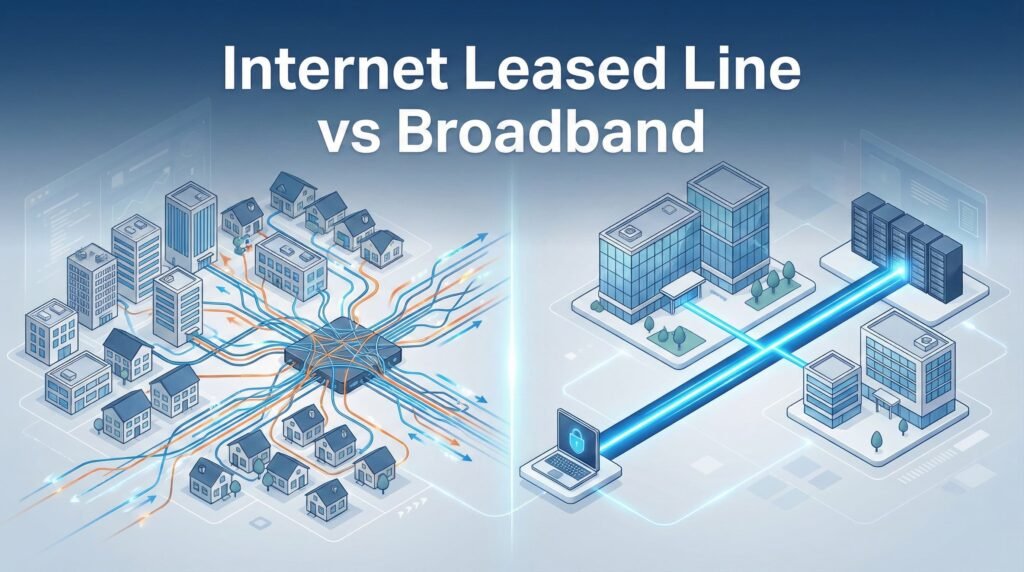
Broadband internet is the most common form of connectivity used by homes and small offices. It typically operates on shared infrastructure such as fiber, copper, or wireless networks, where bandwidth is distributed among multiple users in a locality.
Key Characteristics of Broadband
- Shared bandwidth with multiple users
- Asymmetrical speeds (download is faster than upload)
- No guaranteed uptime or bandwidth
- Cost-effective and quick to deploy
Broadband works well for basic activities such as browsing, email, video streaming, and light business usage. However, as businesses grow and digital workloads increase, broadband often becomes a bottleneck.
What Is an Internet Leased Line?
An internet leased line is a dedicated, uncontended connection provided exclusively to a single organization. Unlike broadband, leased lines offer symmetrical speeds, guaranteed bandwidth, and a strict Service Level Agreement (SLA).
Key Characteristics of a Leased Line
- Dedicated bandwidth (1:1 contention ratio)
- Symmetrical upload and download speeds
- Guaranteed uptime (typically 99.5% or higher)
- Enterprise-grade security and monitoring
- SLA-backed performance and support
Leased lines are designed for mission-critical business operations where downtime, latency, or performance fluctuations are unacceptable.
Internet Leased Line vs Broadband: A Detailed Comparison
1. Performance and Speed
Broadband speeds fluctuate depending on how many users are active on the network. During peak hours, performance may drop significantly.
Leased lines provide consistent speed at all times, ensuring uninterrupted performance even during peak usage hours.
2. Reliability and Uptime
Broadband connections do not come with guaranteed uptime, making them risky for businesses that rely heavily on internet availability.
Leased lines offer uptime guarantees of 99.5% or more, supported by SLAs and proactive monitoring.
3. Upload Speeds
Most broadband plans prioritize download speeds, which limits performance for activities like cloud backups, video conferencing, and data uploads.
Leased lines offer equal upload and download speeds, making them ideal for modern digital workflows.
4. Security
Broadband networks are shared, increasing exposure to external threats.
Leased lines provide private, secure connections, reducing the risk of cyberattacks and unauthorized access.
5. Scalability
As business requirements grow, broadband often struggles to scale effectively.
Leased lines are highly scalable, allowing businesses to upgrade bandwidth without changing infrastructure.
Which Businesses Should Choose Broadband?
Broadband may be suitable for:
- Small offices with limited internet usage
- Startups in early stages
- Businesses with minimal cloud or data requirements
However, even small businesses increasingly rely on cloud tools and remote collaboration, which can strain broadband connections.
Which Businesses Need a Leased Line?
An internet leased line is ideal for:
- Medium and large enterprises
- IT and software companies
- Financial institutions
- Healthcare organizations
- Data-driven businesses
- Corporate offices with multiple users
Any organization where downtime leads to revenue loss should consider a leased line.
The Long-Term Cost Perspective
While broadband appears cheaper upfront, performance issues, downtime, and inefficiencies often result in hidden costs. Leased lines, although higher in initial investment, deliver long-term value, productivity, and reliability.
Conclusion
Choosing between broadband and an internet leased line is not just a technical decision — it is a strategic business decision. For organizations that value reliability, security, and performance, a leased line is a future-ready solution that supports growth and digital transformation.